
It writes the day’s plan before the open, watches for the conditions it defined, and most of the time reports that the condition never formed.
The record · every completed session since Mon, Sep 28
Most of what it does is say no.
written plans became a call
- Sessions
- 20
- With no call at all
- 1
- Names rated
- 460
The numbers, session by session
| Session | Rated | Plans | Calls |
|---|---|---|---|
| Mon, Oct 5 | 23 | 18 | 1 |
| Tue, Oct 6 | 23 | 21 | 1 |
| Wed, Oct 7 | 23 | 18 | 0 |
| Thu, Oct 8 | 23 | 14 | 2 |
| Fri, Oct 9 | 23 | 18 | 3 |
| Mon, Oct 12 | 23 | 17 | 3 |
| Tue, Oct 13 | 23 | 21 | 1 |
| Wed, Oct 14 | 23 | 6 | 3 |
| Thu, Oct 15 | 23 | 19 | 1 |
| Fri, Oct 16 | 23 | 11 | 2 |
| Mon, Oct 19 | 23 | 18 | 2 |
| Tue, Oct 20 | 23 | 20 | 7 |
| Wed, Oct 21 | 23 | 20 | 5 |
| Thu, Oct 22 | 23 | 14 | 6 |
| Fri, Oct 23 | 23 | 19 | 1 |
| Mon, Oct 26 | 23 | 21 | 4 |
| Tue, Oct 27 | 23 | 20 | 3 |
| Wed, Oct 28 | 23 | 22 | 4 |
| Thu, Oct 29 | 23 | 20 | 3 |
| Fri, Oct 30 | 23 | 10 | 3 |
Every rated name gets a plan or a reason it has none. A plan becomes a call only when its trigger clears. A session with no call is not a session the system failed.
NTNT is an informational publication. It does not provide investment advice or recommendations, and nothing it displays is tailored to any individual's circumstances. Options trading involves substantial risk of loss.
Inside the app
These are screens of the member app at the close on Oct 14, as it read that evening. Nothing on them is staged.
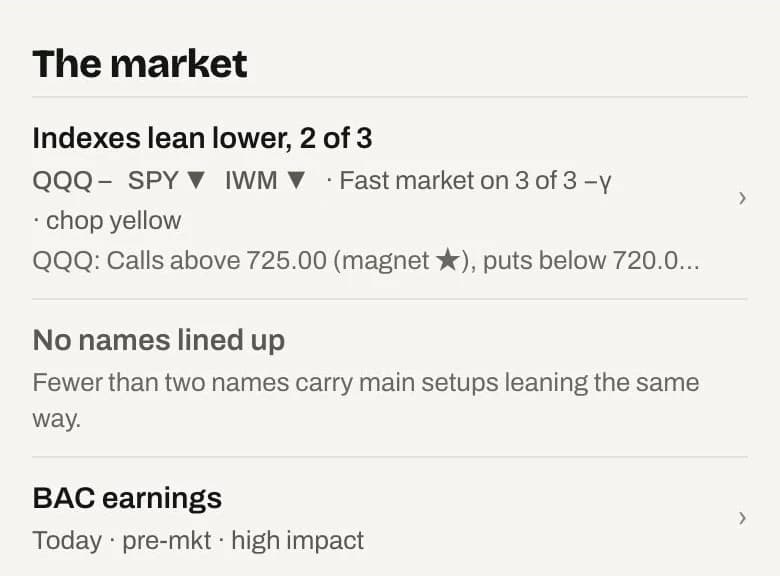
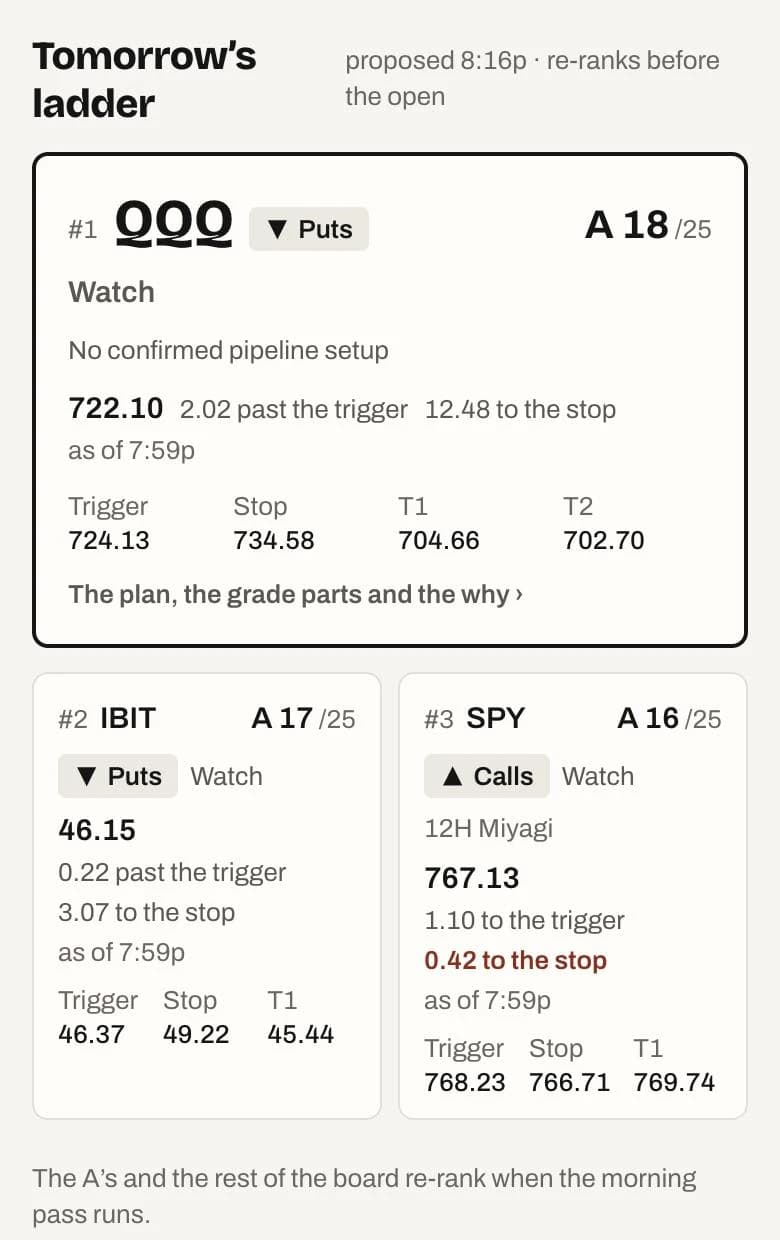
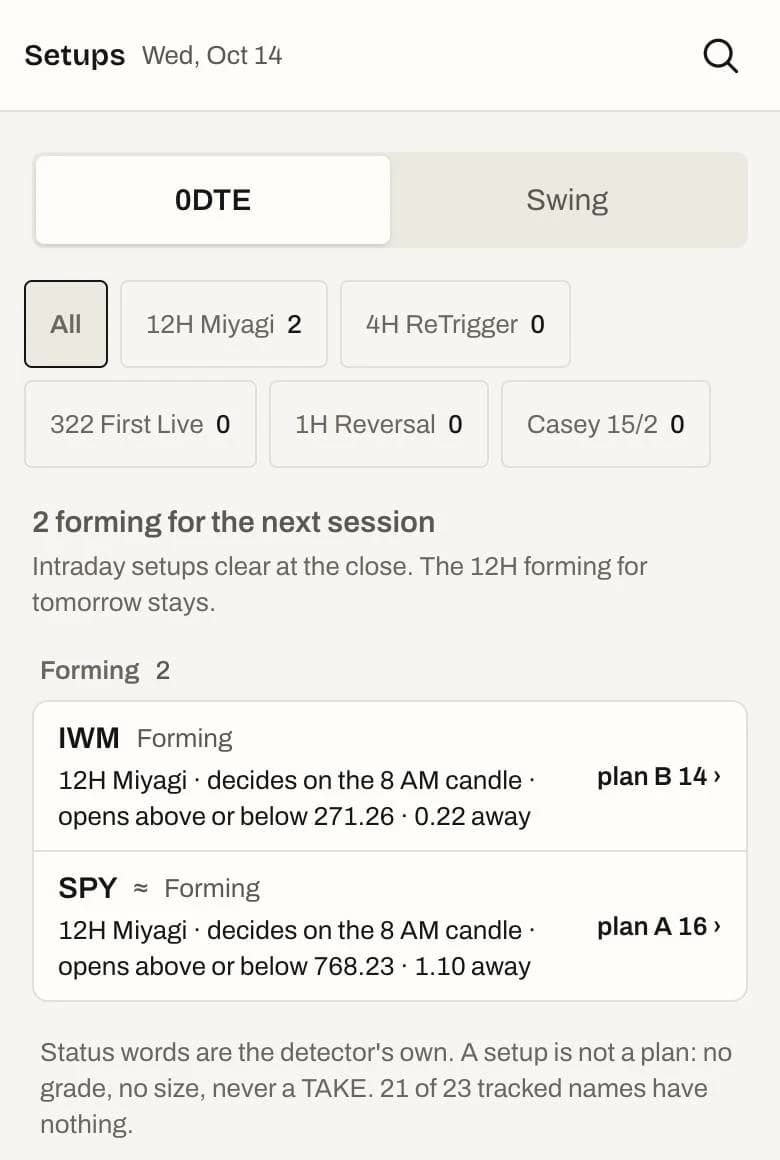
Historical measurement of a rules-based pattern. Not a prediction or a recommendation. Your trading decisions are your own.
Anatomy of a plan
Alerts are cheap. Context is the expensive part. Anything will tell you a level broke; almost nothing tells you how often that break, on that instrument, in that regime, went on to do what you are hoping it does.
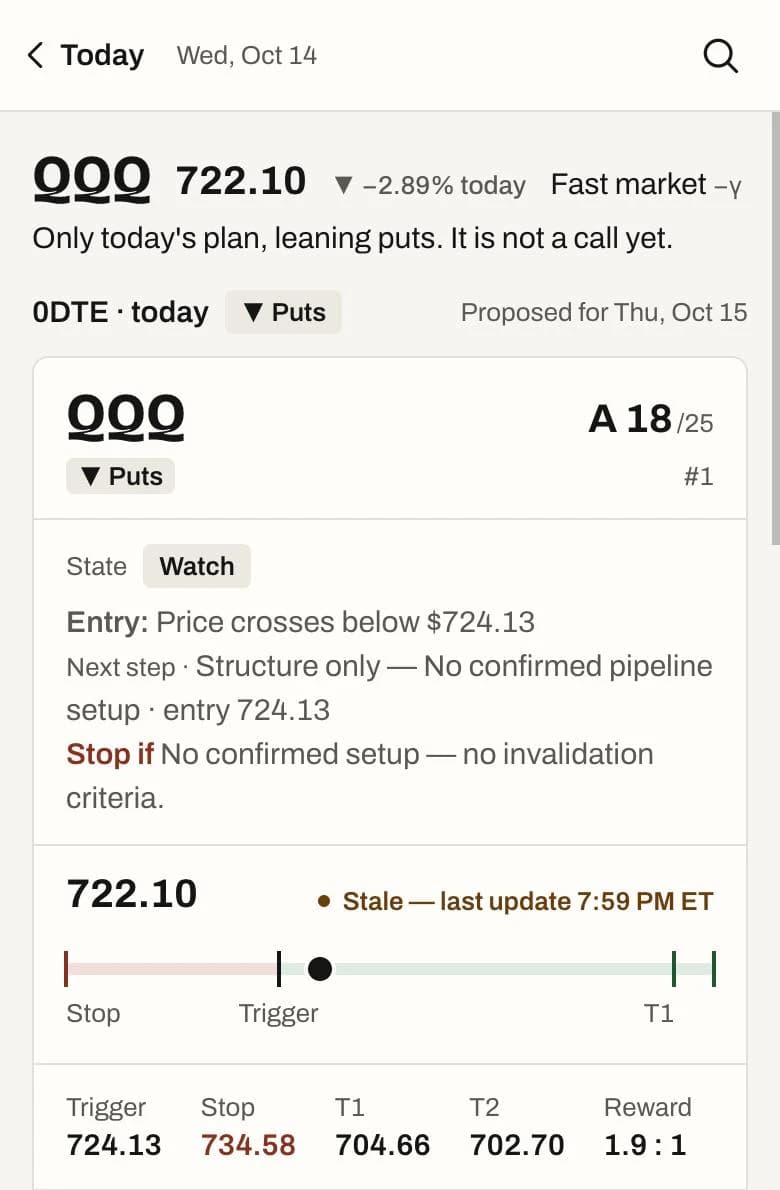
Historical measurement of a rules-based pattern. Not a prediction or a recommendation. Your trading decisions are your own.
- Watch
- A state of the system: a real setup that doesn't qualify yet. Not a directive to a reader.
- Puts
- The direction of the plan. Not an instruction to buy anything.
- Stop
- The price that says the setup failed. The system places no orders; an invalidation is something the pattern has.
- No size
- Position size never appears on this page, and in the app it is never tied to anyone's capital.
A day, in order
The day starts in the morning with a plan that already exists. The evening scan at the end is preparation for the next one, not the beginning of this one.
- 8:45 AMPlans re-ranked. Last night's read is re-scored against the overnight move and the pre-market tape, before anyone is watching.
- 9:08 AMMorning check. Each plan is confirmed, adjusted or killed against what happened overnight.
- 9:30 AMOpen. Watching. Conditions are tracked continuously. A setup goes live only when its trigger clears — most never do.
- Every 60sIntraday tick. Outcomes graded, expired triggers retired, drifted plans regenerated.
- Hourly :33Re-rank. Three minutes after each 1H candle closes, the board is ranked again — unless a position is open, in which case it is left alone.
- 4:02 PMRecord freezes. No retroactive edits to what the system said, or when it said it.
- 5:00 PMSession graded. The day is finalised — every call resolved against the price path, including the ones that failed.
- 8:15 PMScan for tomorrow. Late enough that the day's levels have settled. Positioning, levels and catalysts resolve into the next day's candidates. Then it starts again in the morning.
Every pattern has a number behind it
A pattern only reaches the plan engine if its lower confidence bound clears the threshold on a holdout it never saw. Most do not. These are live counts, not marketing figures.
sessions with a written plan
calls graded against the price path
setup occurrences measured
Scope of measurement
- patterns with a measured base rate
- 1,458
- bars in the study window
- 3,651,528
- tickers covered
- 105
Counts describe the scope of historical measurement. They are not performance figures and do not imply any result. Win rates, holdout rates and confidence bounds are shown to members.
What it will not do
It does not decide for you
No broker connection, no execution, no position sizing against your account. NTNT describes conditions. Every decision and every order is yours.
It is not personalised
Every member sees the same board. Nothing is tailored to your capital, tax situation, risk tolerance or objectives, and it never asks.
It makes no performance claims
No P&L screenshots, no testimonials quoting returns, no projections. Historical base rates, labelled as history.
Who built it
One trader. NTNT is the system I run my own sessions on, and it exists because I needed something that would tell me to sit on my hands and mean it. It is not a content operation and there is no room full of analysts behind it.
Who it is not for
Swing traders. Anyone who wants tips, a room to follow, or someone else to press the button. If you want to be told what to buy, this will annoy you within a day.
Request access
Tell me what you trade and I will know where you fit. One email when a seat opens, and nothing else.
Free while it’s being built. Seats open a few at a time.
Questions
Does it give signals?
It surfaces setups — the condition, the trigger, the level that invalidates it, and the measured history of that pattern. What it does not do is tell you to place a trade, or judge whether one suits you. That call is always yours.
Is this investment advice?
No. NTNT is an informational publication. Everyone sees the same board, nothing is tailored to anyone's circumstances, and it never asks about your finances.
What does it cover?
0DTE on QQQ, SPY and IWM, plus a wider curated watchlist for positioning and context.
Where does the data come from?
Market data from Massive — bars, chains and the tape — with dealer-positioning surfaces, levels and setup detection computed in-house from it.
What do the base rates mean?
How often a pattern historically reached its first target before invalidation, across every occurrence in the study window, checked against a holdout the model never saw. It describes the past. It is not a forecast, and it says nothing about what any individual would have made.
What does it cost?
Nothing yet. It is not for sale — access is by invitation while it is being built.
Why a waitlist?
The system is opinionated and the feedback loop only works small. Seats open a few at a time.